
A roll forming machine is a specialized piece of equipment used for roll forming of metal sheets (such as color-coated sheets, galvanized sheets, and aluminum sheets). Its core mechanism involves multiple sets of rollers progressively pressing and bending flat sheets into standard corrugated waveforms (such as 840, 900, and 910 types). The finished product is then cut to length by a fixed-length shearing mechanism. It is widely used in the production of color-coated steel roofing sheets, walls, and other building envelopes.
The forming machine adopts a mainstream control scheme of PLC,HMI and VFD. The core control logic is as follows:
Speed Control: Supports multi-speed settings (e.g., high speed 50Hz, low speed 10Hz), which can be flexibly switched via 485 communication or PLC terminals to adapt to different sheet material processes;
Positioning Control: The PLC calculates the sheet material length before it reaches the set length (e.g., 2 meters) and instructs the VFD to reduce speed, ensuring a positioning error ≤ ±3mm and avoiding overshoot;
Linkage Control: The frequency converter receives forward/reverse rotation, start/stop, and emergency stop signals from the PLC and links with the hydraulic shearing mechanism and feeding system to achieve continuous cyclic production;
Protection Functions: Equipped with overload, overcurrent, overvoltage, undervoltage, phase loss, and stall protection. Automatic shutdown and alarm in case of faults ensure equipment and personnel safety;
Adjustable Parameters: Acceleration/deceleration time (typically 1-3 seconds), operating frequency, multi-speed priority, and other parameters can be quickly adjusted on-site to adapt to different production scenarios.
The VFD is the core actuator of the roll forming machine's electrical control system, primarily undertaking three functions:
Driving the main drive motor: Providing power to the rolling system, controlling the sheet material feeding speed by adjusting the motor speed to adapt to the forming requirements of sheets of different thicknesses and materials;
Achieving precise multi-speed switching: Working with the PLC to complete the process cycle of "high-speed forming → low-speed positioning → precise cutting," ensuring forming quality and cutting accuracy;
Equipment protection and energy saving: Soft start suppresses current surges, reducing wear on mechanical parts; on-demand speed adjustment reduces energy consumption, while fault monitoring protects the motor and the frequency converter itself.d output various signals, allowing users to intuitively operate and monitor the system.
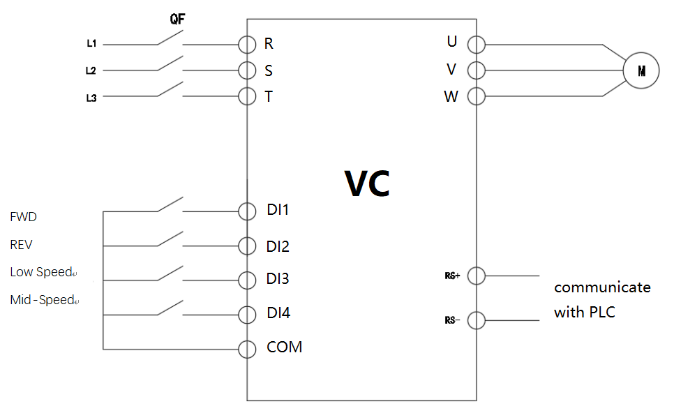
| Parameter | Description | Set Value | Remarks |
| F0.00 | Motor Driving Mode | 0 | SVC Mode |
| F0.01 | Start/Stop command source | 1 | DI terminal |
| F0.03 | Main frequency source | 6 | Multi-stage Speed |
| F0.18 | Acceleration time | 3 | 3s |
| F0.19 | Deceleration time | 2 | 2s |
| F5.02 | DI3 option | 12 | Multi-stage Speed 1 |
| F5.03 | DI4option | 13 | Multi-stage Speed 2 |
| FC.00 | Broadcast Address | 5 | |
| FC.01 | Baud Rate | 6 | 19200bps |
| FC.02 | Modbus Format | 2 | 8,O,1 |
| FD.51 | Multi-stage Speed 0 Source | 0 | RS485 Communication |
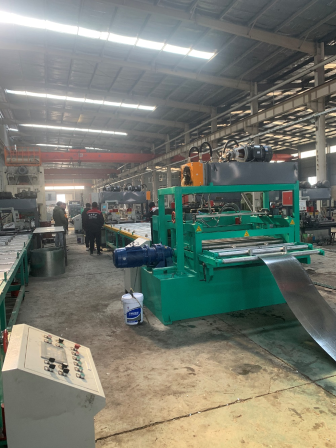
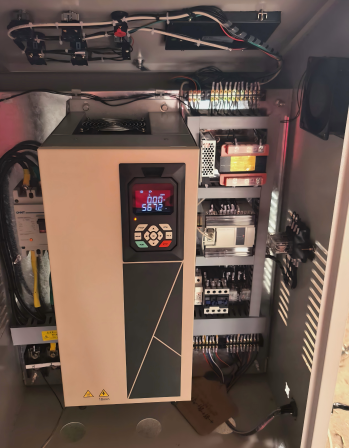
Enhanced Forming and Precision: The VFD delivers high low-frequency starting torque (150% of rated torque at 0.5Hz), ensuring smooth, vibration-free low-speed operation and preventing deformation from sheet metal crushing. Precise multi-speed switching, coupled with encoder feedback, controls cutting length errors within ±1cm, significantly improving tile flatness and dimensional accuracy while reducing material waste.
Significant Energy Saving and Consumption Reduction: Soft start eliminates the current surge from direct motor starting (reducing starting current by 30%-50%), lessening the burden on the power grid. On-demand speed adjustment replaces traditional constant-speed operation at industrial frequency, adjusting speed according to sheet thickness and production rhythm, resulting in comprehensive energy savings of 20%-40%, demonstrating significant long-term cost advantages.
Extended Equipment Lifespan and Reduced Maintenance Costs: Variable frequency operation reduces the mechanical impact of frequent motor starts and stops, decreasing wear on bearings, chains, reducers, and other transmission components, extending the overall lifespan of the equipment. The VFD 's built-in fault diagnosis and protection functions reduce manual troubleshooting time, simplify the control system structure, and lower the difficulty and cost of later maintenance.
Easy Operation and Strong Adaptability: Supports multiple control methods including keyboard, terminal block, and communication. The touchscreen allows for one-click switching of process parameters, adapting to various tile types such as 840 and 900. Its compact size and easy installation minimize electrical cabinet space requirements. Seamless compatibility with existing PLC systems ensures low upgrade costs.
Stable Operation and High Reliability: Employs a current control algorithm to suppress load fluctuations, adapting to the high inertia of the tile press machine's load characteristics. Operation is free from significant speed fluctuations. Strong anti-interference capabilities allow it to adapt to complex electromagnetic environments in industrial settings, resulting in low downtime and ensuring continuous production efficiency.