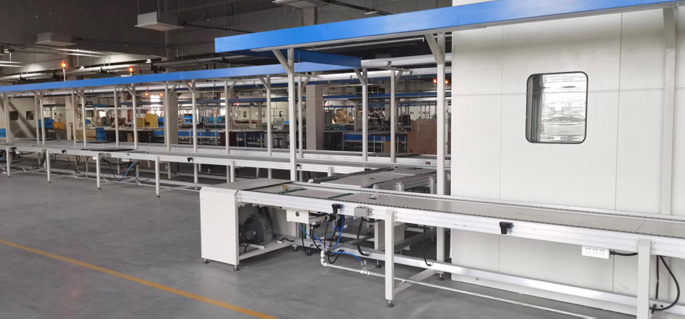
With industrial advancements, Industry 4.0 has been increasingly mentioned in recent years, with "smart factories," "smart production," and "smart logistics" becoming more familiar and being put into practice. Automated production lines have also become a crucial component of intelligent manufacturing within Industry 4.0. An automated production line is a general term encompassing assembly lines, belt conveyors, chain conveyors, and component insertion lines, etc., primarily operated by automated systems without manual intervention. VFDs play an indispensable role in the entire system. Automated production lines inevitably require conveyor systems, which necessitate the use of motors. Since motors themselves cannot achieve automatic speed control, a control unit, namely a frequency converter, is needed to assist in this process. In fact, it has been proven that the vast majority of automated production lines rely heavily on VFDs.
Assembly line equipment is a type of machinery that continuously transports goods along a defined route; it is also known as a conveyor line or conveyor. Based on the type of conveyor products, it can be broadly classified into seven categories: belt conveyors, plate chain conveyors, multi-chain conveyors, insertion conveyors, mesh belt conveyors, overhead conveyors, and roller conveyors. Generally, it includes traction components, load-bearing components, drive units, tensioning devices, redirection devices, and support components. Conveyors can transport goods horizontally, inclined, and vertically, and can also form spatial conveying lines; the conveying lines are generally fixed. Assembly lines have a large conveying capacity, long transport distance, and can simultaneously complete several technological operations during the conveying process, making them widely used.
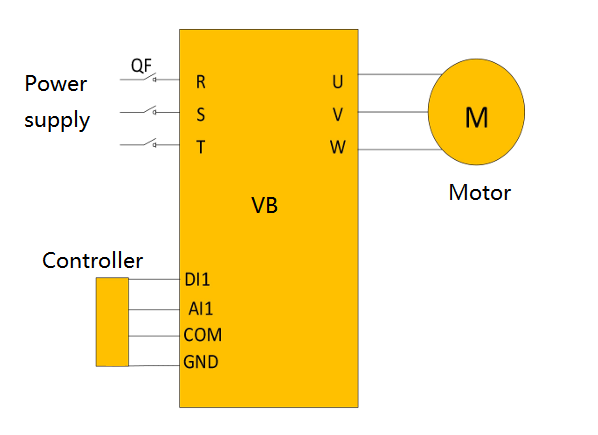
| Parameter | Description | Set Value | Remarks |
| F0.01 | Start/Stop command source | 1 | DI terminal |
| F0.03 | Main frequency source | 2 | AI1(0-10V) |
| F0.18 | Acceleration time | 3 | 3s |
| F0.19 | Deceleration time | 3 | 3s |
| F5.15 | DI Filtering Period | 0.5 | 0.5s |
1)The VB VFD features both digital and analog input functions, allowing connection to a host computer to achieve different conveyor speeds corresponding to different production processes, meeting the speed control requirements of the production system.
2)Automated production lines can reduce manual handling. When used in conjunction with stop devices, it can achieve continuous, rhythmic operation and accumulation of products.
3)The VB VFD uses V/F control, resulting in a smooth and shock-free start-up process.
4)The VB VFD has a comprehensive protection system, protecting the entire system from overvoltage, overcurrent, overheating, and short circuits to ground.