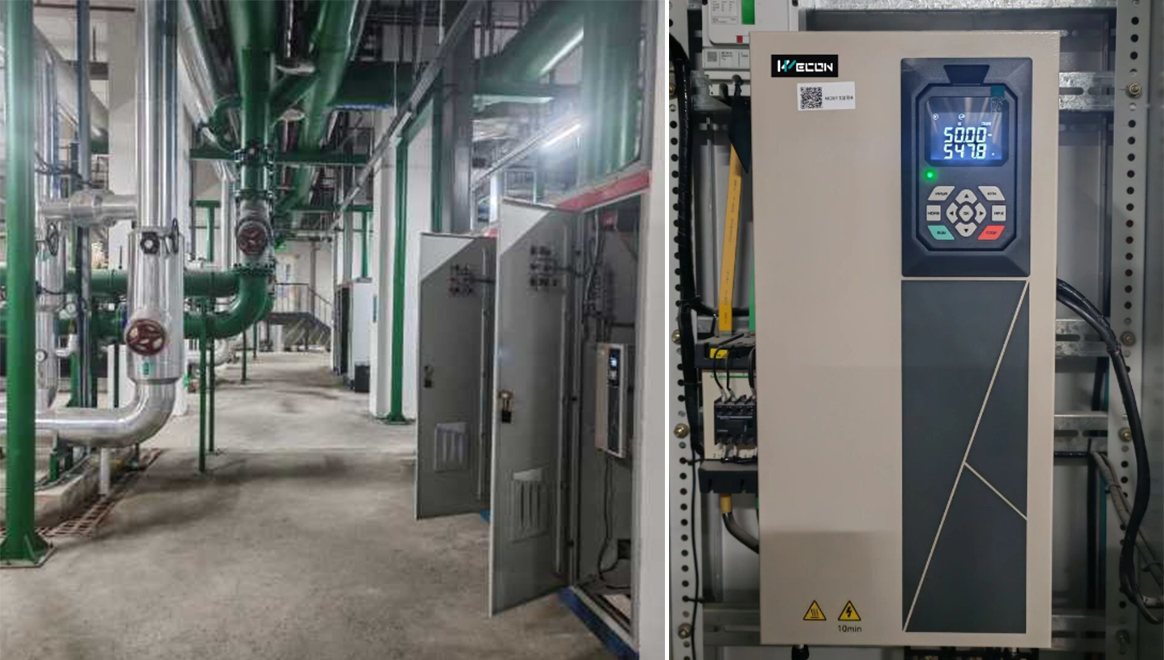
With China’s rapid economic growth and expanding urbanization, numerous public buildings have been constructed across the country, all equipped with central air conditioning systems to meet modern demands for indoor air quality. However, the operation of these systems has raised concerns regarding energy conservation and environmental protection; utilizing the VC series variable frequency drive (VFD) can ensure that central air conditioning systems operate more safely, efficiently, and with greater energy savings.
2* VC-55KW variable frequency drives (VFDs) were deployed on-site (in public hospital)to control the water pumps of the central air-conditioning chiller units, regulating indoor temperatures for the office building and certain public areas.
1) When varying temperatures are required, the variable frequency drive (VFD) controls the water pumps for the cooling or heating units, automatically adjusting their speed to modify pump pressure and flow rates (speed regulation function).
2)It supports centralized control and monitoring of equipment operating data, as well as remote control and frequency command/feedback functions.
3.)The VFD enables smooth motor starting (soft-start function).

| Parameter | Description | Set Value | Remarks |
| F0.01 | Start/Stop Command Source | 1 | DI Terminal |
| F0.03 | Main Frequency Source | 2 | AI1 0-10V |
| F0.04 | Auxiliary Frequency Source | 4 | Keypad |
| F0.07 | Frequency Source Option | 02 | Switchover between F0.03&F0.04 |
| F0.18 | Acceleration Time | 20 | 20s |
| F0.19 | Deceleration Time | 20 | 20s |
| F5.03 | DI4 Option | 18 | Frequency Source Switchover |
| F6.02 | Relay 1 Option | 02 | VFD Alarming |
| F6.03 | Relay 2 Option | 01 | VFD Running |
| F6.10 | AO1 Option | 0001 | 4-20mA |
1) High Level of Automation
Equipped with the VC variable frequency drive (VFD) and a standard dual-line LCD display, the system provides clear visibility of operating parameters and fault information. Its narrow-profile cabinet design minimizes the installation footprint. The system enables centralized control of multiple VFDs and real-time monitoring of operational data; it operates autonomously without manual intervention, thereby reducing labor costs while ensuring high efficiency and stable performance.
2)Dual Energy and Water Savings
The system automatically adjusts the number of active pumps and their operating frequencies based on real-time water demand. Compared to valve-throttling methods, it saves 10%–40% on electricity—with greater energy savings achieved at lower flow rates. It precisely matches outlet pressure to demand, preventing high-pressure leakage in the piping network and conserving water resources.
3) Extended Equipment Lifespan
Variable-frequency soft starting eliminates high inrush currents during motor startup, preventing grid fluctuations, pump surging, and water hammer effects, thereby protecting both piping and pump units.
Low-speed operation reduces motor bearing wear and heat generation, slowing down mechanical aging.
3. Built-in multi-level protection—covering overcurrent, overvoltage, undervoltage, phase loss, short circuits, and overloads—safeguards both the motor and the VFD, ensuring long-term reliability and reducing maintenance and replacement