
Tension control winding is widely used in textiles, paper, packaging, rubber, plastics, wire and cable, and metal processing to ensure product quality by maintaining constant material tension. The industry is shifting from traditional mechanical systems—which suffer from rapid wear and high maintenance—to modern closed-loop vector control solutions like the VC, which offer higher precision, dynamic torque compensation, and self-correcting diameter calculation, driven by trends such as IoT monitoring, AI-assisted adjustment, and energy-efficient designs.
The essence of constant tension control using inverter is closed-loop vector control, i.e., with encoder feedback. For winding, the coil diameter increases from small to large. To maintain constant tension, the motor output torque must increase accordingly. At the same time, appropriate torque compensation must be applied during different operating phases. Specifically, compensation should be tailored for small-diameter startup, acceleration, deceleration, stopping, and large-diameter startup. This ensures a stable winding process throughout, preventing excessive tension during small-diameter winding and loose material during large-diameter startup.
(1) Maintain constant tension throughout the entire winding process. Tension unit: Newton or kilogram-force.
(2) During small-diameter startup, the tension must not be so high as to break the material; during large-diameter startup, the material must not become loose.
(3) No such issues should occur during acceleration, deceleration, or stopping.
(4) Tension must be quantifiable, i.e., the tension value (in force units) should be settable, and the actual coil diameter should be displayable.
(1) Tension setting is performed on the HMI, offering user-friendly operation, with the unit in force (Newton).
(2) Advanced control algorithms are employed: recursive coil diameter calculation; linear tension increase when activating an empty core; application of tension taper calculation formulas; dynamic adjustment of torque compensation, etc.
(3) Real-time coil diameter calculation with very high accuracy ensures smooth output torque from the winding motor. The recursive calculation also enables self-correction of the coil diameter to the correct value in case of operational errors.
(4) The winding mechanism has a large moment of inertia, which increases as the coil diameter grows. During acceleration, deceleration, stopping, or re-activation, yarn breakage or slackening can easily occur, directly affecting yarn quality. With the inverter-based winding retrofit, winding remains stable under all these conditions, with tension kept constant. Moreover, through PLC processing, additional dynamic adjustments are introduced during specific transient states to further improve winding performance.
(5) Retrofitting from traditional mechanical drive winding to inverter-based winding is simple, cost-effective, and requires little to no modification to the existing mechanical setup. The retrofit period is short, typically requiring only two to three days for installation and commissioning.
(6) It eliminates the wear issues associated with mechanical winding, extends the service life of the machinery, and facilitates equipment maintenance.
| Parameter | Parameter Description | Set Value | Remarks |
|---|---|---|---|
| F0.00 | Motor control mode | 2 | Closed-loop vector control |
| F0.01 | Command source selection | 1 | Terminal start/stop |
| F2.16 | Speed feedback or encoder type | 0001 | Encoder type |
| F2.17 | Photoelectric encoder line count | 1024 | |
| F3.11 | Maximum motoring torque | 35.0 | |
| F3.46 | Speed/torque control mode | 1 | Torque control |
| F3.48 | Torque keyboard numeric setting | Communication setting | |
| F3.54 | Torque control positive maximum speed limit | Communication setting | |
| F3.57 | Torque acceleration time | 2.0 | |
| F3.58 | Torque deceleration time | 2.0 | |
| F3.60 | Torque compensation amplitude | 0.0 | |
| F3.61 | Torque compensation threshold torque | 10.0 | |
| F3.62 | Torque compensation cutoff frequency | 2.0 |
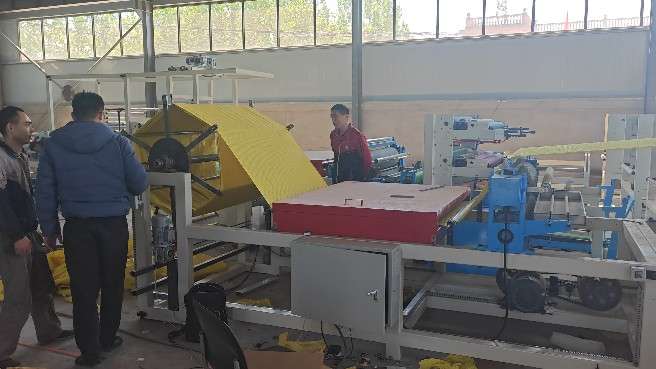
Strong scalability: The system uses the VC with a PG card to achieve closed-loop control, offering fast response and high control accuracy.
The system employs the high-performance VC inverter, enabling rapid and stable start/stop of the equipment. It features high starting torque, low impact on the power grid, and reliable performance especially for long-term continuous operation.
Comprehensive protection: The VC inverter includes built-in protections against overload, overcurrent, overvoltage, and phase loss, significantly enhancing system safety.
The VC supports open communication protocols, including PROFINET, EtherCAT, and RS-485, making it adaptable to various application scenarios.