1 Industry Background
An air compressor uses an electric motor to compress gas in a compression chamber, producing gas at a specified pressure. Air compressors are widely used in metallurgy, machinery manufacturing, mining, power generation, textiles, petrochemicals, and other industries. Conventional air compressors account for approximately 15% of the electricity consumed by large industrial equipment and waste considerable energy. Frequent motor starts shorten motor life, and noise levels are high. A VFD can therefore be used to retrofit screw air compressors for energy savings, delivering a high level of automation and significant reductions in energy consumption.
2 Project Overview
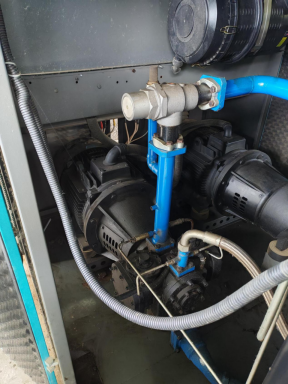
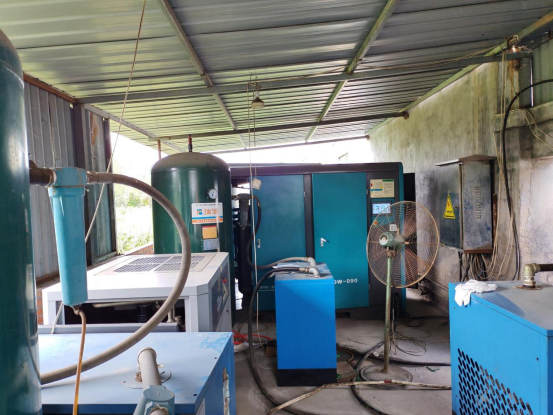
The project uses an air compressor equipped with two 55 kW permanent magnet synchronous motors, two VC-55 kW VFDs, a touchscreen, a PLC, pressure sensors, and associated components.
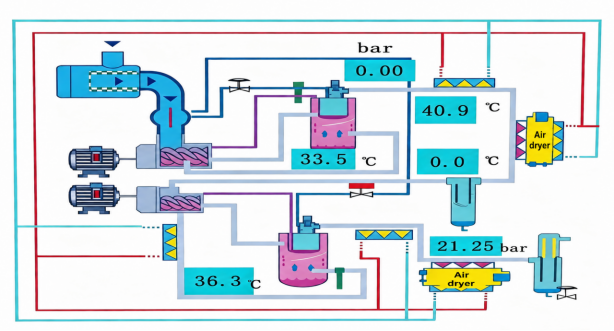
System Schematic
Operating sequence: Ambient air is compressed in two successive stages by the first- and second-stage screw compressor units driven by the VFDs, with oil–air separation performed in sequence. After cooling, the compressed air enters the dryer for moisture removal and then flows into the air receiver to provide a high-pressure air supply. The VFDs automatically adjust compressor speed according to air network pressure to maintain stable pressure. Lubricating oil circulates to cool and lubricate the compressor units, while the system monitors pressure and temperature.
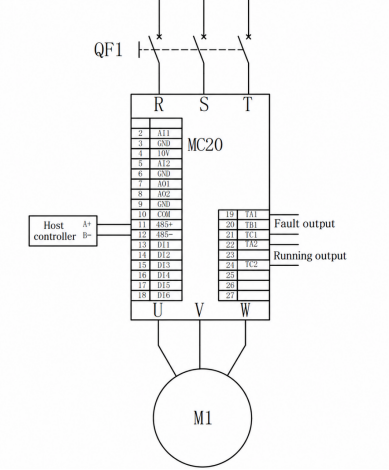
3 Electrical Control Diagram
Parameter Settings
| Parameter | Description | Set Value | Remarks |
| F0.00 | Motor control mode | 0 | Vector control |
| F0.01 | Start command source | 2 | Communication control |
| F0.03 | Main frequency reference source | 9 | Frequency reference via communication |
| F0.18 | Acceleration time | 20 | 20 seconds |
| F0.19 | Deceleration time | 20 | 20 seconds |
| F2.01 | Rated motor power | 55 | Rated motor power: 55 kW |
| F2.02 | Rated motor voltage | 380 | Rated motor voltage: 380 V |
| F2.03 | Rated motor current | 94 | Rated motor current: 94 A |
| F2.04 | Rated motor frequency | 200 | Rated motor frequency: 200 Hz |
| F2.05 | Rated motor speed | 3000 | Rated motor speed: 3000 r/min |
| F6.02 | Relay 1 output | 01 | VFD running output |
| F6.03 | Relay 2 output | 02 | VFD fault output |
| FC.00 | Device address | 01 | Device address: 1 |
| FC.01 | Communication baud rate | 5 | Baud rate: 9600 |
| FC.02 | Data format | 3 | 8, N, 1 |
System Advantages
Significant energy savings: Air demand fluctuates with the compressor load. The VC VFD automatically adjusts speed to actual air demand, replacing conventional fixed-speed operation with unloaded pressure relief. It eliminates energy wasted through frequent starts and stops, substantially reducing electricity costs.
Precise matching to permanent magnet synchronous motors: Vector control provides stable operation of the 55 kW permanent magnet synchronous motors, rated at 200 Hz and 3000 r/min. High torque at low speed and smooth operation make full use of the motors’ high-efficiency operating range, improving overall compressor efficiency.
Motor protection and lower noise: VFD soft starting eliminates the current surge associated with direct-on-line starting. It reduces stress on the motors and compressor mechanical components, extending equipment life. Avoiding frequent starts and stops also reduces noise and makes operation quieter and smoother.
High automation and convenient centralized control: Start commands and frequency references are supplied via Modbus communication, using device address 1 and a baud rate of 9600. The VFDs interface seamlessly with the PLC for remote start/stop, frequency reference control, and centralized monitoring. Relay outputs for running status and faults facilitate coordinated compressor control and fault alarms.
Flexible control and convenient maintenance: Parameters such as acceleration and deceleration times can be adjusted to operating conditions; both are set to 20 seconds in this application. This accommodates changes in compressor load. Running and fault output signals provide timely status and alarm indications, simplifying on-site troubleshooting and maintenance and supporting long-term stable operation.