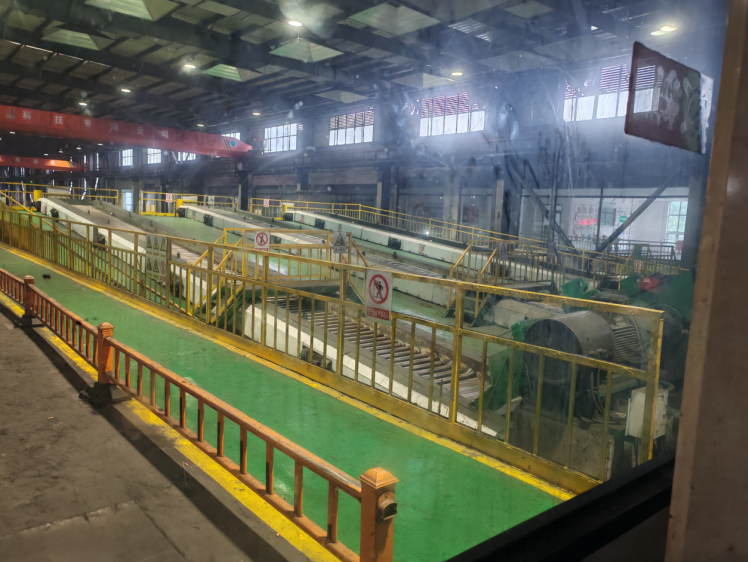
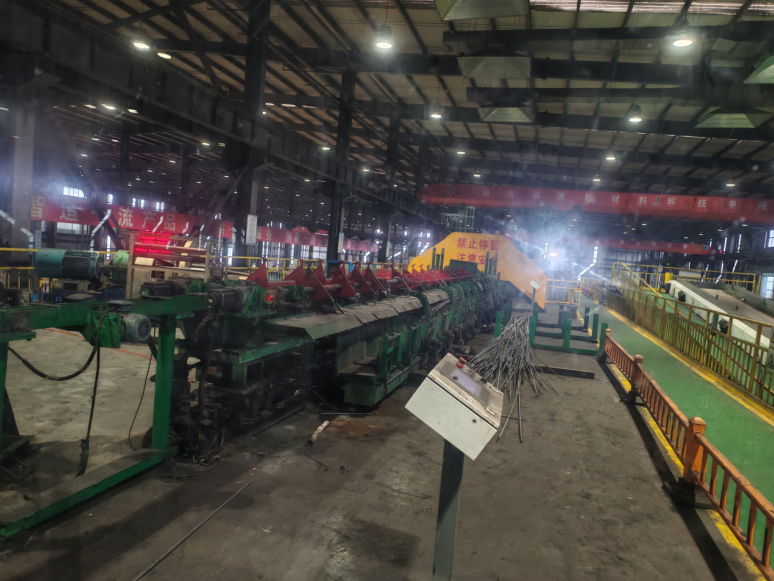
Rebar casting and cutting machines are core heavy-duty equipment for rebar processing and precast component production. They feed cast-and-rolled rebar to preset lengths, cut it precisely, and support continuous production. Conventional high-power machines use direct-on-line starting and constant-speed operation. Common problems include high starting-current surges, insufficient cutting torque under heavy loads, high energy consumption, severe mechanical wear, and poor cut-to-length accuracy. This article describes a high-power VFD retrofit, its control logic, application benefits, and operating results, providing a technical reference for energy-saving retrofits, automation upgrades, and stable, efficient production.
1 Process Description
To match the load characteristics of the machine’s 355 kW heavy-duty motor, an industrial heavy-duty high-power vector VFD is selected. Combined with a PLC control system, encoder-based closed-loop detection, and intelligent multi-speed control, it upgrades the entire machine to VFD operation and meets the requirements of continuous heavy-load production.
The VFD adjusts motor speed by changing the motor supply frequency. Coordinated control is provided by the main controller (PLC), encoder, pressure sensor, and cutting proximity switch.
1. Feeding: The VFD starts smoothly at low speed, feeds the rebar at a constant speed, and counts the feed length.
2. Preset length reached: The controller triggers a rapid increase in VFD frequency and speed, raising hydraulic pump pressure to perform a powerful cut.
3. Cutting complete: The VFD reduces frequency and idles in standby, waiting for the next feeding cycle.
4. Vector control is used throughout to maintain stable torque output under heavy cutting loads.
2 Equipment Selection and Electrical Control Logic
1. VFD selection: The VM heavy-duty high-power vector VFD provides overload capability of 180% of rated current for 60 seconds and 220% for 3 seconds. It can withstand the transient impact loads when the machine engages and cuts rebar, supports full torque at low speed, and prevents stalling under heavy loads.
2. Control system configuration: An integrated PLC, touchscreen, and VFD speed-control system uses encoder speed and position feedback to automate the complete sequence of feeding, positioning, cutting, and resetting.
3. Smooth starting and stopping: An S-curve acceleration/deceleration profile and suitable acceleration and deceleration times provide soft starting and stopping. This eliminates the current surges and mechanical shocks associated with conventional mains-frequency starting and stopping and provides smooth transitions as the load changes.
4. Intelligent speed matching: The operating frequency is automatically matched to the rebar size. Small-diameter rebar runs at low frequency and low speed to prevent misalignment and surface scratches. Large-diameter rebar runs at high frequency with full torque to ensure sufficient cutting force, allowing one machine to handle the full range of rebar sizes.
5. Multiple protective functions: Built-in VFD protection against overload, overcurrent, phase loss, overheating, and motor stall automatically reduces frequency or stops the machine and issues an alarm in the event of jammed rebar, stalling, or overload. This prevents incidents such as motor burnout and cutting blade breakage.
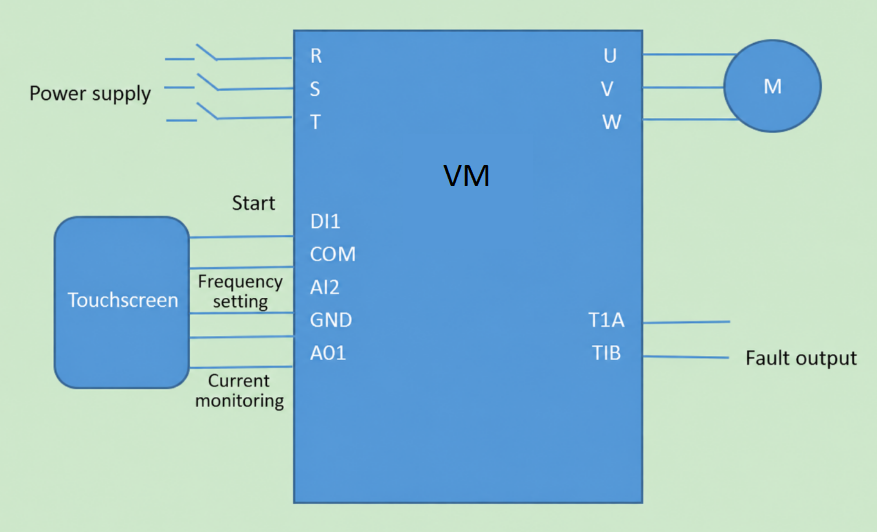
| Parameter | Description | Set Value | Remarks |
| F0.01 | Command source selection | 2 | Via communication |
| F0.03 | Frequency reference source selection | 9 | Via communication |
| F0.18 | Acceleration time | 120 | Adjust as required |
| F0.19 | Deceleration time | 200 | Adjust as required |
| F2.01 | Motor power | 355 kW | Per motor nameplate |
| F2.02 | Rated motor voltage | 380 V | Per motor nameplate |
| F2.03 | Rated motor current | 617 A | Per motor nameplate |
| F2.04 | Rated motor frequency | 50 Hz | Per motor nameplate |
| F2.05 | Rated motor speed | 1480 | Per motor nameplate |
| F6.02 | Relay output selection | 2 | Fault output |
3 Key Benefits of a High Power VFD in Rebar Casting and Cutting
3.1 Smooth Operation and Longer Equipment Life
The high-power VFD provides soft starting and stopping throughout operation and adjusts flexibly to load changes. It effectively cushions the substantial impact loads that occur during cutting, reducing mechanical wear on the gearbox, bearings, hydraulic system, and blade holder and supporting continuous production line operation.
3.2 Precise Speed Control and Higher Processing Accuracy and Capacity
With high torque at low speed and fast dynamic response, vector VFD control allows stepless adjustment of feeding and cutting speeds. This overcomes the uncontrolled speed and poor cutting accuracy of conventional equipment. Stable feeding speed and balanced cutting torque also optimize the production cycle and increase overall equipment capacity.
3.3 Intelligent Energy Savings and Lower Production Energy Costs
The VFD system automatically adjusts output power to the equipment load in real time. During no-load, standby, and light-load operation, it reduces frequency and energy consumption. Under heavy loads, it delivers full torque, eliminating the wasted energy associated with constant-speed mains-frequency operation.
3.4 Stable Power Supply and Fewer Electrical Faults
VFD soft starting keeps starting current smooth and controllable, at no more than 1.2 times rated current. This eliminates the power supply disturbances caused by direct-on-line starting of high-power equipment.
3.5 Compatibility with Automated Production and More Intelligent Operation
The VFD system interfaces seamlessly with PLCs, touchscreens, CNC cut-to-length systems, and complete automated rebar production lines. It supports preset multi-speed operation, one-touch size changes, automatic counting, and fault tracing. These functions automate and intelligently manage casting and cutting operations to meet the flexible production needs of modern rebar processing.
4 Conclusion
Retrofitting a high-power rebar casting and cutting machine with a heavy-duty vector VFD resolves the high impact loads, high energy consumption, poor accuracy, and high fault rates of conventional mains-frequency equipment. Core functions including soft starting and stopping, intelligent speed adjustment, precise closed-loop control, and multiple protective functions improve operating stability, production accuracy, energy costs, and maintenance efficiency.